WeatherData
Weather Data — Full Data Pipeline
Full codebase: github.com/dcremas/WeatherData
Description
A full data pipeline building a Postgres data warehouse of hourly, by-location weather observations for 112 US airport stations from 2005 to the present day, so that barometric pressure change can be analysed over time and compared across locations.
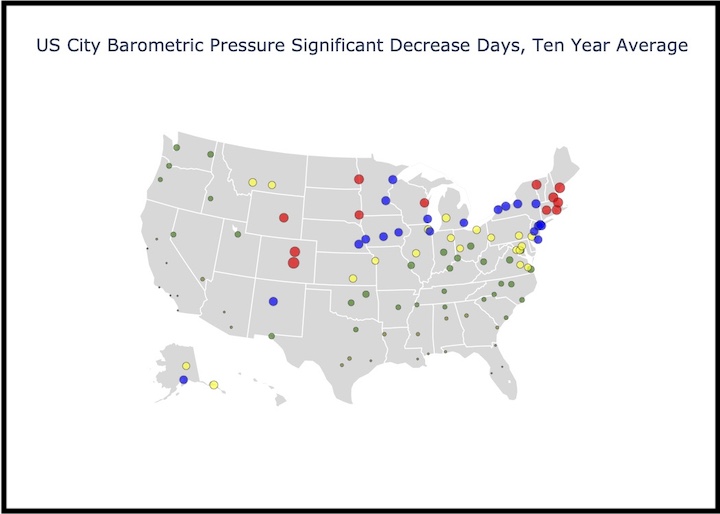
Data sources — and the 2025 migration
This project originally sourced NOAA’s Integrated Surface Database (ISD) via
the global-hourly HTTPS directory. NOAA stopped adding to ISD in 2025:
observations stop in late August 2025, and no 2026/ directory was ever created.
The archive itself is still served — https://www.ncei.noaa.gov/data/global-hourly/access/
lists 1901/ onward and returns the historical years fine. What ended is new
data, not the service, so a pipeline pointed at it fails by silently reading a
year that never grows rather than by getting an error. The AWS mirror
noaa-global-hourly-pds tells the same story: its year prefixes stop at 2025/.
Current observations therefore come from GHCNh (Global Historical Climatology
Network — hourly), ISD’s official replacement. All 112 stations map cleanly: an
ISD id is a 6-digit USAF id plus a 5-digit WBAN, and the GHCNh id is USW000 +
the same WBAN.
| Period | Source | Notes |
|---|---|---|
| 2005 – 2024 | ISD | historical; source no longer updated |
| 2025 – present | GHCNh | current; refreshed by re-reading the whole year |
Where the data comes from
Documentation and station metadata: ncei.noaa.gov/products/global-historical-climatology-network-hourly
The files this pipeline reads live in the NOAA Open Data bucket
noaa-ghcnh-pds, which needs no credentials. It publishes the same observations
two ways, by-station and by-year; the loaders use by-year:
https://noaa-ghcnh-pds.s3.amazonaws.com/hourly/access/by-year/<year>/parquet/GHCNh_<ghcnh_id>_<year>.parquet
For example, Chicago O’Hare (ISD 72530094846) in 2026:
https://noaa-ghcnh-pds.s3.amazonaws.com/hourly/access/by-year/2026/parquet/GHCNh_USW00094846_2026.parquet
metadata/stations.csv holds the ISD ↔ GHCNh id pairs for all 112 stations, and
is what both ghcnh_generate.py and the download Lambda iterate over.
GHCNh republishes the whole in-progress year in place rather than publishing deltas, so there is no incremental fetch — refreshing means re-reading the year. It also revises recent observations after the fact, which is why the nightly load rebuilds two months rather than one.
Validated against 811,329 overlapping observations: report type matched 100%,
temperature 99.96%, wind 99.82%, visibility 99.94%, precipitation 99.99%. The
remaining differences are almost entirely cases where ISD stored an all-9s
“missing” sentinel that its converters turned into a real-looking number
(99999 → 295.30 inHg, 9999 → 2236.7 mph), where GHCNh correctly reports
NULL.
Known gap: GHCNh itself has no data for 2025-08-30, 08-31 or 09-01, at the handover. No source can fill those three days.
ISD sentinel cleanup
ISD encoded a missing reading as an all-9s code rather than NULL, and the original
loaders converted whatever they found. A missing sea-level pressure therefore
became 295.30 inHg, a missing wind 2236.7 mph, a missing temperature
1831.8 F. sql/cleanup_isd_sentinels.sql replaced these with NULL across the
2005-2024 rows - 2.87M rows locally, 948k on the serving warehouse - bringing the
historical era in line with how GHCNh reports missing data. The script documents
each value’s derivation and is safe to re-run.
Two things were deliberately left alone: cig = 13.67 (ISD code 22000 is
“unlimited ceiling”, a real observation) and seven one-off prp readings above 20
inches that are mislabelled multi-hour accumulations rather than sentinels.
obs_baro_impact was verified byte-identical before and after, since the
sentinels already fell outside its slp BETWEEN 20 AND 35 and prp <= 10
filters.
Pipeline
NOAA Open Data (noaa-ghcnh-pds)
  │  ghcnh_generate.py <year>      112 threaded downloads, 329 cols -> 18
  ▼                                ghcnh_files/<year>/*.parquet
                                   ghcnh_parquet/<year>/data.parquet
  │  ghcnh_process.py <year> [month] [local|remote]
  │    · keeps FM15/FM12 only, normalised to FM-15/FM-12
  │    · rejects readings GHCNh flags suspect/erroneous (QC 2,3,6,7)
  │    · converts to F / inHg / mph / miles / inches
  ▼    · DELETE slice + COPY replacement in ONE transaction
Postgres  observations
  │  sql/analytics_slp_decrease.sql   LAG 3/6/24hr sea-level-pressure deltas
  ▼
obs_baro_impact  ->  consumed by the bokeh_server visualisations
Reference dimensions load independently: loc_data.py (locations),
regions_build.py (regions), time_zones.py (time zones).
Running in AWS, nightly
The pipeline above is what runs by hand. In production it runs itself, once a
day, as two Lambdas driven by EventBridge Scheduler — the same shape as the
apple_weatherkit ELT. Deployment source lives in
~/Documents/aws/ghcnh_pipeline.
NOAA noaa-ghcnh-pds
  │  ghcnhDownloadS3        07:30 America/Chicago   no VPC
  ▼                         112 parquets -> combined, staged, promoted
s3://noaa-ghcnh-weatherdata/ghcnh_parquet/<year>/data.parquet
  │  ghcnhPostgresqlUpdate  07:45 America/Chicago   in VPC
  ▼                         current + previous month -> observations
EC2 Postgres  ->  obs_baro_impact, loc_subset  ->  bokeh apps
Daily because GHCNh republishes the whole in-progress year daily, with about a two-day lag. The window is the current and previous month, not just the current one: GHCNh keeps revising recent observations, and a current-month-only job would stop looking at the previous month the moment it rolled over.
The two functions sit on opposite sides of the VPC out of necessity. NOAA’s bucket is in us-east-1, this VPC’s only S3 route is a us-east-2 gateway endpoint and there is no NAT gateway — so the downloader cannot be in the VPC, and the loader must be, because the warehouse listens on a private address.
The Lambdas run this repo’s shared_funcs.py and sql/*.sql, copied into
the layer and the function package at deploy time, so there is one implementation
of the transform rather than a fork. A fix here reaches production by rebuilding
the layer.
Failure is quiet by design: every guard refuses to write rather than writing
something wrong, so a broken run leaves the warehouse serving good but stale
data and nothing downstream looks different. CloudWatch alarms on both functions,
plus one that fires if the loader stops running at all, publish to the
ghcnh-pipeline-alerts SNS topic.
The EC2 warehouse is now the system of record. The nightly job has no route
back to this machine, so the local copy is a dev copy — refresh it on demand
with python ghcnh_process.py <year> <month> local.
bash_scripts/monthly_refresh.sh and its LaunchAgent are retired; the script is
kept as the manual fallback for when AWS is unavailable or the local warehouse
needs feeding.
Format differences that matter
GHCNh is not a drop-in replacement for ISD. Each of these silently corrupts a
load if missed, and all are handled in shared_funcs.py:
- Units. ISD packed measurements as integers in tenths; GHCNh publishes real units. Reusing the ISD converters yields values 10× too small. Visibility also changed from metres to kilometres while ceiling height stayed in metres.
- Report types lost their hyphen —
FM15/FM12, notFM-15/FM-12. They are normalised back so existing analytics SQL keeps working. - Provenance is per-variable, not per row, so
report_typeandsourceare derived from the variables in priority order. - Quality codes. GHCNh grades every reading; ISD had no equivalent. Readings flagged suspect or erroneous are stored as NULL — without this a QC-7 reading of 219 °C lands in the warehouse as 426 °F.
- Precipitation is split across accumulation periods. ISD packed whatever depth was reported into one field, so the period columns are coalesced.
- Source codes are not comparable across the boundary: GHCNh uses 3-digit codes, ISD used a single digit.
Transform performance
ghcnh_transform reads the combined parquet one row group at a time and
pushes the report-type and period filters down onto the Arrow table before
converting anything to Python.
It used to call table.to_pydict() on the whole file and loop over every row —
correct, but it materialised all 5.9M rows across 32 columns as Python objects in
order to keep the ~50k that survive the filters. That peaked at 4.4 GB and 130
seconds for a single month, which no Lambda would host. Filtering in Arrow
first leaves the per-row mapping byte-identical while holding one row group in
memory: 924 MB and 7.7 seconds for a two-month window, 24-50x faster on a
month. A whole-year load is unchanged, since almost every row survives the filter
and there is nothing to push down.
Loading performance
Loads use COPY ... FROM STDIN, not row-wise INSERT. The warehouse is reached
through an SSH tunnel with ~44 ms latency, where an ORM bulk insert degrades to
~151 rows/sec — a 1.2M-row year takes over two hours. COPY sustains ~77,000
rows/sec over the same tunnel, so a full year lands in about 40 seconds. The
delete and the COPY commit together, so readers never see a half-loaded slice.
Usage
# Refresh the current year end to end
python ghcnh_generate.py 2026
python ghcnh_process.py 2026                  # whole year -> remote
python ghcnh_process.py 2026 7                # July only
python ghcnh_process.py 2026 7 local          # July only -> local

# Rebuild the analytics table
./bash_scripts/run_psql.sh

# Verify file record counts against the warehouse
./bash_scripts/checksum_yearly.sh 2026
Loads refuse to run rather than write bad data: an empty or implausibly short batch aborts before the delete, and a completed month whose coverage stops short of the month end raises instead of being published as complete.
Technologies
- Python:
pyarrow,polars,pandas,numpy SQLAlchemyand the SQLAlchemy ORM for schema definition- Postgres, loaded via
COPY - Advanced SQL: CTEs, window functions,
CASEexpressions - Command line and bash scripting
Folder structure
Top level holds the Python and bash scripts, plus:
/metadata— helper files, includingstations.csv, the 112-station ISD↔GHCNh roster the GHCNh scripts read./output_files— exploration output./sql— analysis scripts, run both from the command line and by the loader./bash_scripts— psql runner, record-count checksum, manual refresh fallback./aws— the nightly pipeline: two Lambda handlers, the layer manifest and the deploy scripts. See aws/README.md./ghcnh_files,/ghcnh_parquet,/yearly_files_csv,/yearly_files_parquet— bulk source data, not committed (size).
Removed
The ISD-era loaders — current_year_generate.py, current_year_process.py,
update_aws_monthly.py, update_aws_yearly.py and explore_files.py — were
deleted once the GHCNh path went live. They targeted the global-hourly HTTPS
directory, which still serves its historical years but has received no new data
since August 2025 and has no 2026/ — so running them now would quietly load a
stale year rather than fail.
They remain in git history as the record of how 2005–2025 was collected:
git show 613ff24:current_year_process.py
Collaborators
Thank you to the National Oceanic and Atmospheric Administration for making all of your rich data available to the masses.
License
Released under the MIT License.